Community-based monitoring is increasingly important for improving collaborative natural resource management worldwide. Strengthening community-based monitoring is a priority agreed by 195 countries in the Kunming-Montreal Global Biodiversity Framework
It is highly relevant in Mongolia, where it can help address urgent social and ecological challenges. Central Asia, and the Arctic share several important similarities in relation to natural resource use, perspectives of community members, and the impacts of climate change:
- Many people depend on living resources for their livelihoods.
- Rural communities, including herders and local resource users, maintain strong connections to the land and its living resources, and hold extensive knowledge of collaborative management practices and systems.
- Climate and societal changes are having severe impacts on people living on and from the land.
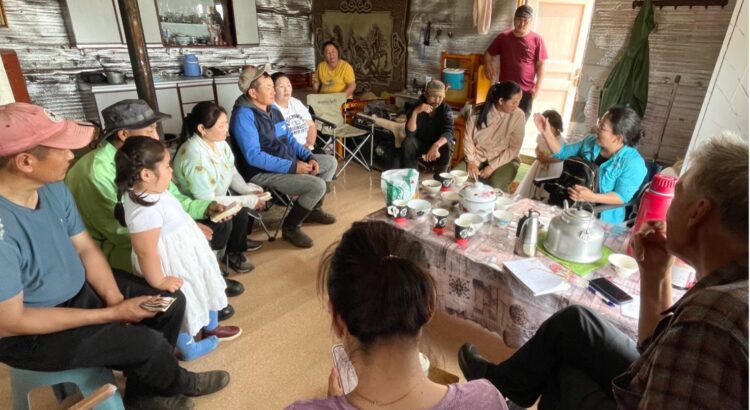
To date, there has been limited exchange between Arctic countries and Mongolia on community-based approaches to monitoring and managing living resources. A new initiative of the UArctic Thematic Network on Collaborative Resource Management and the Mongolian National University of Education will change that. In June, staff of the University and NORDECO met with four communities of pastoral land users and land managers in North Mongolia to discuss current approaches to collaborative natural resource management and monitoring. The experiences from the meetings will serve as central input into the process of finding out how in practice to ensure that the ‘voice’, knowledge and perspectives of the herding communities can be incorporated into natural resource management decisions.
The new initiative aims to develop practical, shared steps for using community-based monitoring to inform decisions on the management of living resources. It will also explore how herder communities’ knowledge and scientific knowledge can better inform one another. The goal is to produce guidance that can be applied to Mongolia while also offering inspiration and practical value across the Arctic. Cross-Arctic experience will be central to developing robust and useful guidance.